
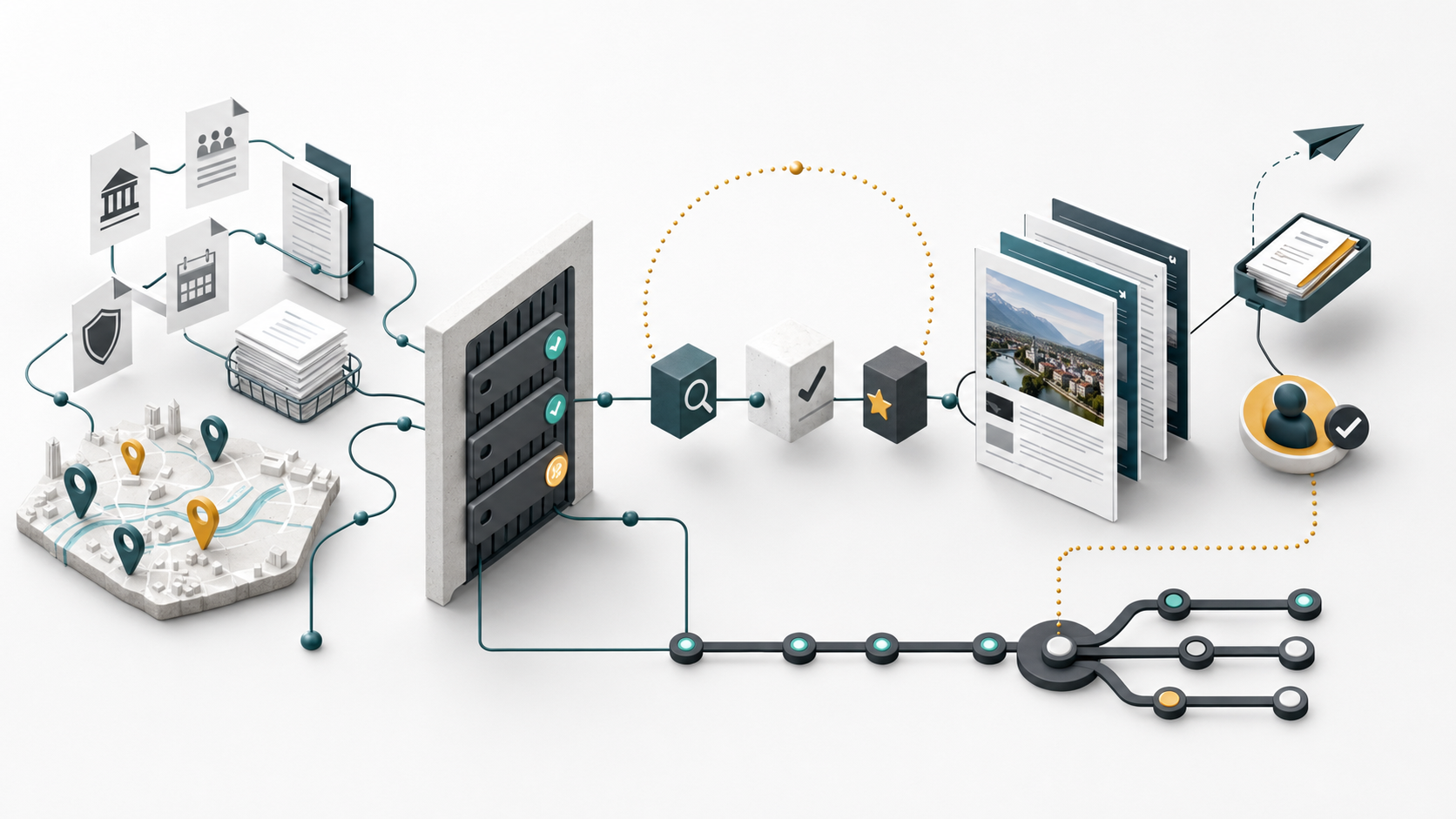
How the quality run works
Sources, maps, copy, checks, human stops, and publishing do not blur together. Each part has a task and a boundary.
Public Quality Standards
SalzburgTeen is the first public field test of an agentic department in real operation. The site tests whether clear roles, strong sources, hard gates, and human stops can create lasting local value.
Updated: 15 May 2026
An article or major change may only go live when the hard gates are clean. Warnings trigger review. Learning signals move into the next improvement cycle.
hard gates block publishing
Official or clearly checkable sources come before polished wording.
Age, cost, place, route home, signup, language, and caution are checked.
The site must build, stay readable, and not break on small screens.
Green changes may be published. Outreach stays in draft until human approval.
Sources, maps, copy, checks, human stops, and publishing do not blur together. Each part has a task and a boundary.

Measurement, report, priority, and repair form a loop. Safe website work may continue. Emails and promises stay protected.
Research Gate
The research gate is the source check before publishing. It blocks invented prices, opening hours, age rules, contacts, routes, and overconfident claims when a source is weak.
official or clearly checkable source
current verification date
Salzburg City relevance
clear limit when uncertain
Online checklist
This table is intentionally concrete. It shows what is checked, how a red signal is detected, and how a problem must be repaired.
Official or clearly checkable sources first.
Concrete check
Every new or strongly revised guide needs real links, a date, and a clear source for prices, times, age, and contact.
Evidence
Source block in the article, source audit, metadata with verification date.
Red signal
A page claims opening hours, prices, age limits, or contacts without a checkable source.
Repair
Add the source, make the claim more careful, or remove the detail.
Useful copy matters more than bold copy.
Salzburg City is the core; surrounding areas are clearly marked.
Concrete check
The page says whether an offer is in Salzburg City, easy to reach, or better treated as a trip.
Evidence
District field, place data, mobility note, internal Salzburg scope.
Red signal
A surrounding-area tip looks like a regular city tip.
Repair
Mark it as a trip, explain the route, or remove it from the guide.
SalzburgTeen should first work for teenagers in the city.
Support, school, or stress topics avoid diagnosis and false promises.
Concrete check
Pages separate orientation from advice. Crisis, violence, health, and school topics stay careful and point to fitting services.
Evidence
Support category, contact route, wording check, no cure-like promises.
Red signal
The page sounds as if the site alone can solve a personal problem.
Repair
Name the limit, link a professional service, verify emergency or contact information.
Orientation may be clear, but must not pretend to be professional advice.
Youth organizations need a reviewable profile page before outreach.
Concrete check
Every public organization profile contains an offer map, official links, practical checks, source date, and concrete review questions for the organization.
Evidence
data/youth-organization-profile-details.mjs, content:youth-organizations, public profile route, outreach safety report.
Red signal
An organization receives only a general hub link or a thin profile without offers and review questions.
Repair
Check the official source, then add at least three offer clusters, official links, practical limits, and review questions.
A good review link helps the organization find errors quickly.
10- to 15-year-olds should be able to like the text; parents should see quality.
Concrete check
Short sentences, simple words, clear examples, no fake youth slang, and no specialist education language.
Evidence
Plain-language pass, copy check, content evaluator, manual spot check.
Red signal
A 10- or 11-year-old would need to guess many words.
Repair
Shorten the sentence, add an example, explain the specialist term directly.
Simple does not mean childish.
Claims are stated directly.
Concrete check
Public copy avoids recognizable contrast templates where a weaker idea is set up before the real point arrives.
Evidence
Copy check for UI and standards, content evaluator, rewrite queue, plain-language pass.
Red signal
A sentence reads like a replaceable AI formula: first a contrast image, then the claim.
Repair
Put the real point first, shorten the sentence, and remove the contrast setup.
Good copy sounds clear, concrete, and human.
The first screen quickly says: who it is for, where, rough cost, next step.
Concrete check
Title, intro, and metadata show usefulness, target age, place, cost logic, and next action.
Evidence
Frontmatter, hero copy, content card, mobile visual check.
Red signal
The page sounds interesting, but no one knows what to actually do.
Repair
Add concrete place, cost range, age, and action.
Good orientation saves time.
English is not a side version.
Concrete check
German and English carry the same meaning, sources, caution limits, and useful local explanations.
Evidence
Bilingual coverage check, translation audit, 216/216 English guides.
Red signal
English loses facts, overclaims, or reads like a literal translation.
Repair
Update the English page and check facts against the German version.
Language may become easier, facts may not.
The canonical GitHub repository is the publishing source.
Concrete check
Automations run in the right repo, push to main, and publish only after green gates.
Evidence
Git status, main branch, origin remote, publish report, Vercel status.
Red signal
A working copy is accidentally treated as a second source of truth.
Repair
Compare differences deliberately, merge relevant changes, archive or clearly label the working copy.
Autonomy needs one clear source.
Visual checks look for mobile issues, cut-off text, and broken layouts.
Concrete check
Important pages are checked on desktop and mobile. Text must not overlap, buttons must remain usable.
Evidence
Browser Use check, screenshots, build, lint, contrast spot check.
Red signal
A central page is broken or hard to read on mobile.
Repair
Tighten layout, raise contrast, improve wrapping and tables.
Quality also means whether the page is actually usable.
New rules must move with the public and machine-readable standards.
Concrete check
When a gate, process, or quality criterion is added, the standards dataset, quality page, and Excel workbook update in the same publish run.
Evidence
data/public-quality-standards.json, standards page, standards:workbook, standards:check, publish gate.
Red signal
A new internal rule exists, but the public quality page or Excel file does not show it.
Repair
Add the rule to the standards dataset, rebuild the workbook, run the drift check, and publish only after that.
Quality rules matter only if they remain findable.
Emails are prepared, but not sent automatically.
Concrete check
Outreach, newsletters, and organization emails remain drafts. Direct sending is blocked until a human reviews. New or refreshed organization drafts stay short. A `sent-incident` is a hard stop until Momo manually reviews the sent message.
Evidence
Outreach safety check, draft status, sent-folder check, `sent-incident` status, blocked send action, short draft template.
Red signal
An automation could send without human approval or continue after an unreviewed sent incident.
Repair
Remove send permission, use the draft-only module, check the sent folder, get Momo to manually resolve any sent incident, and shorten the new draft to 110 words max.
Preparing is allowed. Sending and sent-incident clearance remain human.
Youth organizations in Salzburg should be visible fairly and invited.
Concrete check
Fitting drafts include the short yes/no question asking whether the organization would generally be interested in joining a possible meeting at Magazinstraße 4.
Evidence
Organization data, outreach queue, draft copy, no send trace without approval.
Red signal
The wording sounds like a promise, partnership, or obligation.
Repair
Use the standard question, claim no promise, imply no partnership, and ask only for a short yes.
The goal is a better-connected youth network in Salzburg.
Article images need clear origin and visible usage rights.
Concrete check
Every automatically assigned article image must come from the checked image pool and include a source, credit, and license or free-use rule.
Evidence
data/article-image-pool.json, data/article-image-assignments.json, docs/article-image-candidates.md, and visible image credits in the article.
Red signal
An image looks fitting, but source, license, credit, or article fit cannot be traced.
Repair
Remove the image from live assignment, leave it open in the report, or replace it with a better documented image.
A good image helps only when its origin stays clean.
Weak spots become visible and move into the next work queue.
Concrete check
Evaluators write reports; rewrite queue and idea engine prioritize the next repairs and opportunities.
Evidence
Content evaluator report, rewrite queue, source audit, idea engine report.
Red signal
A problem is detected, but disappears from the system.
Repair
Add the report item, set priority, trigger automated or manual repair.
The system improves because problems leave a trace.
Strong safe ideas move into implementation.
Concrete check
The idea engine scores teen benefit, parent benefit, Salzburg relevance, source situation, effort, risk, recency, outreach need, and human-send requirement. If direct website candidates are waiting, a run must do real material work or stop with a blocker; ideas already visible on the site must not keep blocking the direct queue as unfinished work. Source-check sections count as body evidence, while source lists alone do not prove source depth.
Evidence
data/idea-backlog.json, data/autopilot-implementation-queue.json, docs/idea-engine-report.md, docs/autopilot-implementation-queue.md, docs/autopilot-actionability-report.md.
Red signal
A safe, valuable website idea remains only a note, or a completed idea reappears as open direct work.
Repair
Implement the highest safe website idea in a small scope, run gates, and publish after green results; report-only only with a clearly documented blocker or proven completed status.
The site improves when strong safe ideas turn into real work.
Safe ideas may continue; risky ideas need a stop.
Concrete check
The idea engine may trigger content, data, and structure work, but must not send emails, spend money, or promise partnerships.
Evidence
Idea backlog with blocked actions, outreach safety report, autopilot status.
Red signal
An idea needs legal, financial, or public commitment.
Repair
Store it as a draft or research task, do not execute automatically.
Autonomy stops where responsibility must become personal.
The system does not improve by making free decisions. It learns because every run leaves traces: reports, queues, blocked actions, and next repairs.
Checks read content, sources, translations, layouts, images, and data.
Every run writes reports instead of guessing silently.
Hard failures come before new ideas. Safe ideas with high website value move into the direct implementation queue.
Content, data, hub, and translation work may continue after green gates. Email, social, money, partnerships, and commitments stay draft-only or human-stopped.
The next run improves source, language, data, or layout.
Repeated problems become new rules.

Editorial illustration, created with OpenAI image generation on 22 August 2026. It is not a portrait or a documentary photograph.
Operator and method
Momo builds agentic departments for companies, education projects, and local initiatives. That means AI systems receive tasks, rules, data, checks, and clear limits. SalzburgTeen shows this method publicly through a useful local example.
Source profile: Momo FeichtingerZukunftBilden GmbH, Magazinstraße 4/Top 5, Salzburg
Agentic departments for content, research, outreach, and operations
Human stops for email, money, promises, and sensitive decisions
SalzburgTeen as a first public field test for real local value